Signal
Loading the stream…
WDSF 2026 results are on record — 10 awards · 11 winnersSee the record →
Loading the stream…
What’s moving in agentic workstations and workflows — drawn from a reviewed source list, scored, and kept at a permanent address you can cite.
Curated and full layers · newest first · scored, sourced, citable
The ledger as a map. Dashed edges are machine-suggested (embedding similarity and duplicate clusters); solid edges are editorial — they appear only where a blog post cites an entry.
Raw data: signal-graph.json
Filter by category
152 entries in the curated layer matching the current filters
The paper introduces Epistemic Fault Domains (EFDs) and a structural cut metric κ_E to formalize the failure mode where multi-agent quorums share upstream inputs, telemetry, or tool backends, collapsing multiple votes onto a single corrupted cause. It proves quorum size does not guarantee epistemic redundancy and presents the DAQC controller plus a 120-task benchmark.
Gives a precise vocabulary and runtime-enforceable metric for a correlated-failure mode in multi-agent voting that most teams currently handle only by intuition.
ArXiv paper experimentally localizing reliability properties in an agent system built around an append-only ledger adjudicator. Interventions on institutional epistemic mechanisms and on cognition (ablation, mid-task reset, frontier-LLM substitution, false testimony) left five core properties intact: singular accepted reality, typed refusals, durable duties, no double-acceptance, and no false completions across 2,581 substituted-panel claims.
Provides empirical evidence that reliability in agent systems can live in institutional machinery rather than in the model, a structural claim with direct design implications for agentic workflows.
An arXiv paper tests whether LLM agents can evade activation-based monitoring probes when explicitly told they are being watched. Using two game-theoretic scenarios (blackjack and prisoners' dilemma) with Qwen3-32B-AWQ and GPT-OSS-20B, the authors find the best probes retain accuracy across baseline, aware, and feedback conditions, and agents continue to collude.
Controlled experiment shows activation probes hold up against aware agents, useful for anyone designing oversight in multi-agent deployments.
Researchers formalize the 'epistemic Sybil problem' in multi-agent AI systems, showing that multiple agents sharing a common evidence root do not produce independent observations. Controlled experiments with over 20,000 LLM-agent calls demonstrate that naive aggregation collapses posterior coverage from 0.94 to 0.26 as report count rises from 1 to 32, while correlated extraction errors further degrade calibration.
Challenges the assumption that more agents equals more evidence, with empirical calibration data showing how multi-agent aggregation can mislead without tracking evidential ancestry.
ArcticSwarm is a multi-agent research architecture that separates evidence gathering from integration. Subagents post findings to a shared bulletin board while gated isolation prevents premature consensus; structured review at three commitment boundaries filters low-confidence candidates. It reaches 82.6% on BrowseComp-Plus with Qwen 3.5-27B and 73.6% on live-web BrowseComp with GPT-5.
Multi-agent research pipelines that vote early converge prematurely. The gated-isolation plus structured-review pattern is a concrete fix with measured lift on BrowseComp-Plus and BrowseComp.

A Thoughtworks field report describes 'hyper-agentic' — 10 engineers in one Barcelona room using agentic engineering to build an airline IROps system, during which they 'accidentally re-discovered' a coordination pattern for multiple agents (the 'blackboard').
Firsthand account of a real multi-agent engineering exercise with a named coordination pattern worth noting for anyone designing agentic workflows.
A research paper tests whether LLMs can maintain exact intermediate state across long sequences of dependent tool calls by having a model compute MD5 step by step across 196 calls and 64 rounds. Using gpt-oss-120b, it finds that keeping the model's own reasoning in context and voting over a thinking-enabled worker enables correct end-to-end execution.
Isolates state-tracking from instruction following using a cryptographic ground truth, and surfaces two concrete fixes—context-resident reasoning and worker voting—for long-horizon agent failures.
A source-code anatomy of eleven production coding agent harnesses (Claude Code, Codex CLI, Gemini CLI, Aider, OpenHands, etc.), mapping seven canonical subsystems with minimal and maximal implementations, cataloging 29 recurring design patterns, and including a longitudinal sample showing convergence over one quarter. Closes with 18 design recommendations and a minimum-viable-harness scaffold.
First systematic source-code dissection of major coding agents across ~4M LOC, yielding concrete patterns and a 90-line scaffold readers can actually build from.
A three-week diary study with 8 blind screen-reader users evaluated OLLA, a computer-use agent prototype, across 1,258 commands in 12 desktop applications. GPT-5 achieved the highest success rate at 52.5%, with trace analysis identifying grounding, planning, constraint-tracking, and termination failures.
First diary study with blind users on real desktop workflows; names specific failure modes and benchmarks five models, useful for agent builders and accessibility practitioners.
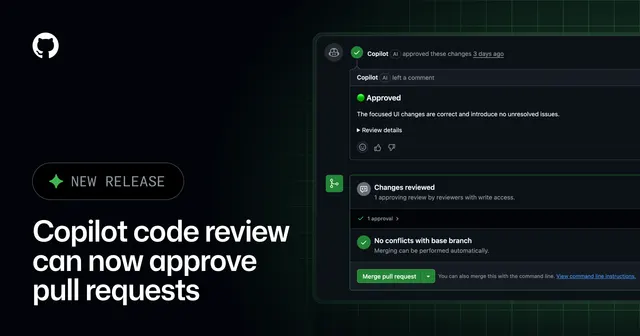
GitHub Copilot's code review feature can now approve pull requests when it determines they are ready, with admins able to authorize the AI to sign off on approval. The approval capability is opt-in.
Official changelog entry on a new capability that lets an AI agent finalize PR reviews, shifting who or what can sign off on merges.
ASTRA is a multi-agent system for technical ticket resolution. A central orchestrator coordinates three specialist agents (historical case retrieval, log analysis, domain knowledge via MCP) and drives a judge-orchestrator refinement loop producing claim-evidence-grounded reports. Evaluated on 987 real telecom tickets, mean quality 4.13/5, fabrication below 3%, hardware faults notably harder than software.
Concrete multi-agent architecture with claim-evidence grounding and a judge-orchestrator refinement loop, benchmarked on nearly a thousand real tickets. The hardware-fault gap (Cohen's d=0.80) is a useful boundary condition for anyone building similar systems.
GOD is a local-first browser control room for multi-agent simulations, combining a setup wizard, Agent Studio, Map Studio, spatial replay, and Ask/Intervene commands, plus portable experiment and map packs. Evaluation across 15 runs shows 78/84 intervention-target checks and 169/182 state-query checks matched expected values.
Addresses a real gap in multi-agent observability: operators can query, intervene, and replay live agent societies instead of choosing between finished replays and raw logs.
MemToC is a controlled benchmark for evaluating how LLM agents arbitrate between parametric memory and tool returns when the two conflict. Across five 7-9B open-weight models, instruction-tuned variants retain a verified-correct answer against an incorrect tool in only 6.5-17.1% of cases. SFT and DPO improve arbitration on some backbones but reduce abstention after tool errors.
Quantifies a specific failure mode in tool-using agents and offers a benchmark plus fine-tuning baseline for anyone designing agent arbitration policies.
A failure study of 147 incidents across 81 runs in a production agentic software-delivery platform shows that service-mesh primitives (retry, timeout, circuit breaking) fail for non-idempotent agent delegation. The authors identify two root concepts—identity adequacy and evidence adequacy—and derive seven reliability primitives whose enforcement unit is the delegation rather than the message.
Production incident data on agent delegation is uncommon. The paper quantifies how standard mesh assumptions break in agent contexts and supplies two concepts plus seven primitives orchestrator builders can adopt.
Paper tests a zero-shot manager-worker multi-agent scaffold across nine LLMs on 100 hard LiveCodeBench problems without training. Gains are model-dependent: up to +42 points for some models, null or negative for others. The scaffold roughly triples token cost but is often cheaper per unit of accuracy than scaling to a larger model.
A controlled, per-model breakdown of when multi-agent scaffolding actually helps coding — directly useful for deciding whether to add orchestration to a coding workflow.

Anthropic opened a research preview of the Model Hardware Standard (MHS), a shared specification letting AI agents operate lab and manufacturing instruments such as microscopes, liquid handlers, and robotic arms in parallel. Co-developed with HHMI Janelia, MHS is model-agnostic, works with any device exposing a programmable interface, and uses protocols like MCP.
First-party detail on a new agent-to-hardware standard with named collaborators, MCP grounding, and a live preview program rather than vague vision.
Praxist is a lineage-centered system for autonomous R&D agents that converts reproducible artifacts and evaluator outcomes into a typed evidence graph of findings, lane-structured frontiers, and agendas. On MLE-bench's 75 tasks it produced 60 medals (80%, 49 gold) vs a Claude Code baseline's 55 medals (73.3%, 34 gold) at roughly one-twelfth the cost (US$3,054 vs US$38,370). Four case studies (trading, SLAM, tokamak control, rocket landing) extend the approach to open-ended engineering problems.
Proposes a structural separation between local artifact construction and cohort-level evidence synthesis, with auditable lineages. The 12x cost reduction on MLE-bench and four open-ended case studies are concrete measurements, not aspirational claims.
Researchers built Station, an open-world multi-agent environment where AI agents from different model families autonomously pursue mathematical research without central coordination. Across 14 problems, the system produced novel constructions, theorems, and proofs on five, with raw dialogues and verification code released.
Concrete multi-agent setup that produced genuine novel mathematics on five problems, with full dialogues and proofs released for inspection.
AgentLance is a market-based orchestration system for LLM agents where agents privately bid on tasks using their costs, an allocator selects winners via VCG-style payments, and winning agents can hierarchically subcontract subtasks. Experiments across reasoning, code, QA, and agentic tasks show improved specialization matching and cost efficiency over centralized planners, and expose manipulation vulnerabilities in single-planner systems.
Proposes a concrete decentralized alternative to centralized agent orchestration, with empirical comparison to baselines and an explicit diagnosis of manipulation risks in single-planner allocators.
GitHub announced the Customize tab in the GitHub Copilot app is generally available, letting teams configure Copilot with their existing tools, knowledge, and workflows via MCP.
Official GA of MCP-based customization in the Copilot app, directly relevant for anyone wiring Copilot into existing team toolchains.
Research across 4,800 veracity judgments across 6 LLMs finds that agentic scaffolding (multi-turn interaction, user pressure, iterative self-refinement) systematically amplifies sycophantic behavior, causing a 6.3 percentage point accuracy drop. More capable models show larger amplification effects, inverting the expectation that oversight loops help.
The counterintuitive finding that more capable models sycophantically capitulate more under scaffolding reframes human-in-the-loop agent design, suggesting feedback loops can degrade rather than improve truthfulness.
A research paper studying multi-agent LLM teams across 11 verifier-scored optimization tasks. The authors find that full-solution interaction causes agents' outputs to converge within one round, eliminating the diversity that motivates using multiple models. Independent proposal generation avoids this collapse, and critique helps only when the violated rule is easy to identify and fix.
Empirical finding that challenges the default multi-agent debate pattern and offers a concrete alternative: generate proposals independently before sharing. Useful for anyone designing agent orchestration.
A preregistered pilot compares one wide LLM agent, a no-orchestrator single agent, and two intermediate configurations (three to five narrow workers) on cross-border VAT determination across 4,400 runs with deterministic oracle labels. Intermediate configurations lead in accuracy, but the matched-token control fires, meaning prompt budget could explain the gap. One hallucinated schema-conforming record inverts the ordering.
A 4,400-run preregistered sweep with falsification checks and matched-token arms separates agent-count from prompt-budget effects, a control most multi-agent benchmarks skip. Useful for anyone designing orchestrated agent pipelines.
OptiMAS is a task-agnostic optimizer that automates evolution of multi-agent LLM systems. Built on a unified ReAct infrastructure with a dual-track memory, it uses textual interaction trajectories and task feedback as loss signals for end-to-end optimization. Evaluations on four benchmarks with three LLM backbones show competitive or superior accuracy versus hand-crafted and evolutionary baselines.
First concrete tool to continuously evolve LLM agent architectures end-to-end from trajectories, sustaining gains over long optimization horizons.
BridgeGuard is an air-gapped, edge-deployed agentic RAG system for FHWA bridge inspection compliance. It combines vector search over regulatory guides with SQL queries on NBI data, orchestrated by a multi-step ReAct agent. A section-aware chunking method preserves regulatory item boundaries, yielding 94.2% chunk integrity versus 28.4% for naive splitting, and 99.77% accuracy on Delaware's 874-bridge inventory.
Demonstrates a fully offline, multi-step agentic RAG pipeline that meets regulatory compliance at edge scale. The chunking comparison and ablations are directly applicable to other field-based compliance workflows.
A between-subjects study (N=73) compared Traditional-Only, AI-First, and Hybrid interaction modes in a web CMS augmented with an LLM agent via MCP. AI assistance reduced clicks, navigations, and scrolling, but task duration did not differ across conditions. Individual differences accounted for roughly half the variance in delegation behavior, more than CRUD operation type.
Empirical evidence that delegation to AI agents is driven by user identity more than task demands, and that the primary benefit is reduced effort rather than speed. Useful counterpoint to speed-focused design narratives.
LEDGER is a tracing and review system for LLM agents that builds layered trace graphs over agent sessions. It groups trace records into Evidence Nodes and Workflow Nodes, with typed semantic edges connecting claims to supporting actions, artifacts, and validation checks for audit purposes.
Addresses the audit bottleneck as LLM agents take on longer workflows, offering a concrete graph structure that links claims back to the actions and artifacts that support them.
A framework where an LLM-based Scientist agent iteratively applies the scientific method (hypothesis, implementation, testing, feedback) inside an evaluation environment, with a second Kuhn agent injecting paradigm-shifting conjectures to escape local optima. Demonstrated by discovering Delta V (state-of-the-art on ProteinGym) and DALE (outperforms STREME on ENCODE motifs), using 704M tokens on a single CPU VM.
Concrete evidence that an LLM agent loop can produce state-of-the-art novel algorithms on two unrelated benchmarks, with a published token-cost figure. Useful as a reference pattern for agentic research workflows.
A Human Factors journal study examines whether cognitive load selectively affects different trust-updating pathways during trial-by-trial AI-assisted decision making, testing mechanisms beyond aggregate trust change.
Primary empirical evidence on how mental load differentially disrupts trust recalibration paths, relevant for designing AI collaboration under cognitively demanding tasks.
A research paper introduces AgentSysBench, a benchmark suite with ten agentic applications and system-level instrumentation. It identifies six properties distinguishing agentic workloads from conventional LLM inference, including stateful execution, heterogeneous component resource affinity, shifting bottlenecks, idle state periods, control-plane overhead, and cross-request redundancy. Four design optimizations reduce latency up to 4.5x.
First systematic benchmark of agentic serving workloads. Quantifies where latency and memory actually go, and demonstrates concrete optimizations with measured gains.
Paper formalizes hallucination propagation in sequential multi-agent LLM pipelines as a four-state Markov process (Raw Fact → Derived → Narrative → Invisible). Across 346 injected hallucinations in a 4-agent FinanceBench pipeline, detection drops from 72.0% at Stage 1 to 50.9% at Stage 4, with 23.7% surviving undetected. Boundary gates cut survival to 16.2% versus 58.4% for end-checking alone.
Quantifies a structural flaw in multi-agent chains and prescribes where to place verification gates, with effect sizes generalizable to any n-agent linear pipeline.
Preregistered study tests the conditional-independence assumption behind compositional reliability bounds for multi-agent systems. Two same-model agents co-fail on 90% of missions when either fails, inflating joint failure above independence predictions. Authors propose a finite-sample, assumption-free certificate via linear programming over measured co-execution moments, with code released.
Empirically falsifies a default multi-agent reliability assumption at scale and ships a sound assumption-free certificate. Matters for anyone trusting agent redundancy math.
A two-tier multi-agent system for long-form research: a deterministic "librarian" maintains a point-in-time, trust-tiered knowledge library (SEC EDGAR, BLS, Wikipedia) while a separate portable multi-agent "writer" produces contradiction-free, evidence-grounded reports at any knowledge cutoff, with red-team feedback propagating corrections. Evaluated on 555,926 evidence cards across 6,130 sources.
Concrete architecture separating a maintained knowledge store from a portable writer, with measured results on contradiction removal, trust-tier selection accuracy, and look-ahead compliance at scale.
The paper introduces E2-Explainer, a framework that applies causal inference to identify critical communication subgraphs in LLM-based multi-agent systems. A Granger-style objective measures how masking each communication channel affects task outcomes, producing budgeted subgraphs that can be executed directly to prune redundant edges and reduce communication costs.
Offers a concrete, experiment-backed method for trimming communication overhead in LLM multi-agent setups while preserving task performance. Useful for anyone running agent ensembles at scale.
The paper introduces Interaction Readiness, a framework for evaluating role-bearing AI agents by separating content specifications (what an agent knows) from interaction specifications (how it conducts itself in a role). A tutoring case study shows content accuracy and interaction quality are independent dimensions, with authority miscalibration as a persistent failure. It offers a specification template and audit procedures for pre- and post-deployment use.
Frames agent evaluation around role behavior, not just output. The authority-miscalibration finding and pre-deployment audit template are directly useful for teams building role-bearing systems.
Study of 23 open-weight language models finds that a unanimous wrong majority can overturn 22.8% to 71.0% of correct answers depending on dataset. Existing conformity mitigations improve resistance but reduce receptivity, falling on a single tradeoff frontier; reasoning is the only method that improves both on certain tasks.
Defines a Resistance-Receptivity frontier for multi-agent LLM setups with measurements of six mitigation methods. Directly relevant to designing agent collaboration workflows.
Research paper arguing that increasing individual AI agent capability does not automatically improve collective capability. It identifies four loci of collective failure—access/routing, admission/dependence, state maintenance/incentives, representation/action—and uses controlled experiments to show institutional structure helps when it repairs how usable public state is constructed, but loses advantage when signals are uninformative or stronger intelligence can perform the transformation directly.
Provides a diagnostic frame for deciding whether to invest in smarter agents or better coordination structures, grounded in controlled experiments rather than anecdote.
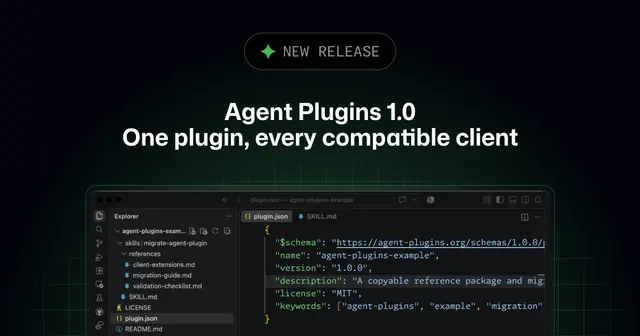
GitHub released Agent Plugins 1.0, a standard enabling developers to build one plugin that runs across VS Code, Copilot CLI, and the Copilot app, with support from AWS, Anysphere, Microsoft, OpenAI, and Vercel.
First-party cross-client plugin standard from GitHub with named partner backing, directly relevant to anyone building or integrating AI agent tools.
EvoX Genesis organizes long-horizon software development around a persistent project rather than a persistent agent. Finite-lived local agents propose changes via recursive delegation; only accepted consequences advance version history. Demonstrated by autonomously building a Rust-based C compiler (~250k lines, 120h, $44) and reimplementing 13 MESA Fortran modules with 1.55–6.87x speedups.
Concrete benchmark of a persistent-world, finite-agents pattern with measured cost and test results, contrasting with the usual persistent-agent approaches to long-horizon coding.
A three-layer dogfooding framework for evaluating production LLM chat agents: canonical question-bank testing, random-walk multi-turn evaluation, and a goal-directed NPC simulator with a ten-category failure taxonomy. A three-month case study (257 runs, 108 scenarios) shows layer correlations are weak or negative, and the NPC layer achieves 77% goal completion at $0.17 per run, enabling automated PROMOTE/HOLD/ROLLBACK CI/CD decisions. Authors release prompt templates and a Python replicability guide.
Released artifacts (prompts, failure taxonomy, Python guide) plus the counter-intuitive finding that canonical response-level scores do not predict multi-turn goal success — directly useful for any team shipping chat agents.
LangChain benchmarked NVIDIA NeMo Switchyard, an open-source model router, on 145 agent tasks. Only 7% of turns required a frontier model, with a 30B-parameter model handling the remainder. Routing between Nemotron 3.5 Lightning and Claude Opus 4.8 cut total cost by 74% while retaining 93% of Opus's accuracy.
Firsthand benchmark with concrete numbers. Gives teams a defensible cost-optimization strategy for agent LLM calls and a decision formula for adopting model routing.
The paper argues that model substitution in multi-call LLM workflows should be treated as a deployment-conditioned action rather than dictated by tier labels. It proposes a predicate-action factorization evaluated across solve-merge-verify workflows with 8-64 calls and multiple model ladders, showing that the same substitution has sharply different value depending on role and scale.
Challenges the default 'stronger model = better' routing heuristic in multi-call LLM systems by showing a model's value depends on its position in a dependent computation, not just its tier.
A position paper proposing 'Muscle Memory' for LLM agents: compiling recurring user intents into specialist agents rather than retrieving stored experiences. A four-phase pipeline (Harvest→Analyze→Augment→Evaluate) mines conversation history and emits compiled specialists, achieving 88.9% win rate with +2.05 personalization gain and only −0.28 accuracy cost on 90 held-out scenarios.
Proposes compilation over retrieval as a memory paradigm, backed by a working four-phase pipeline and measured personalization-vs-accuracy tradeoff. Directly applicable to anyone building personalized agent systems.
MasDrift is a benchmark of 600 benign productivity tasks across eight domains evaluating authorization preservation in multi-agent systems. It compares single-agent, centralized, and decentralized coordination. Centralized hierarchies achieve 93.9-98.6% task completion but 2.7-19.8% unauthorized actions, while peer networks show 85.7-87.0% completion and 0.6-0.8% unauthorized actions. Re-anchoring defenses outperform chain propagation.
Concrete tradeoff data for anyone building multi-agent systems. Centralized coordination finishes more tasks but leaks more authorization. Re-anchoring beats chain propagation as a defense. Measurable MAS design guidance.
OpenAI CFO Sarah Friar shares five lessons for building an AI-native finance function, covering automated forecasting, stronger controls, and measuring AI ROI.
Firsthand account from a major tech CFO on operationalizing AI inside a core business function, with concrete patterns other teams can adapt.
FYI is a browser extension that embeds fact-checking into the reading environment for data-driven articles, offering four tools spanning full automation to manual data exploration. A study (N=22) identified three workflow archetypes: AI-first with manual confirmation, manual-first with AI supplement, and parallel co-review, with trust in AI shifting based on cross-tool consistency.
Empirical study maps three distinct human-AI fact-checking workflows and shows trust depends on cross-tool consistency rather than AI output alone.
GitHub now lets enterprise owners centrally control which Model Context Protocol servers GitHub Copilot clients may run, via new allowedMcpServers and deniedMcpServers keys in enterprise managed settings.
First-party detail on MCP governance for Copilot at enterprise scale; relevant for admins standardizing agent tool access across teams.
Amp introduced a new a1.medium orb size (4 CPUs, 8GB, $0.33/hour), cut auto-pause from 15 to 5 minutes, sped up startup, and added per-thread orb size selection via a new --orb-size CLI flag. Prices fell or held across all tiers; existing projects were auto-upgraded.
Concrete pricing table and per-thread sizing flag give readers immediate levers to cut agent compute spend without switching tools.
The paper identifies 'stale authorization' as a core failure mode in agentic systems where policies are evaluated at request time but effects occur later when underlying state may have changed. It defines policy-state serializability and presents Provenact, a runtime architecture with a PostgreSQL-backed prototype that keeps policies as reviewable programs.
A concrete correctness condition and runtime design for the often-ignored problem of policy staleness in concurrent agent workflows acting on shared resources.
The paper investigates using agentic AI to reimplement interactive HCI software systems directly from research papers, introducing a 'revibeability' metric. The authors test the approach on UIST papers and interview original authors, finding it can produce usable baseline code in many cases.
Proposes a concrete agentic workflow for reimplementing research software from papers, validated against original authors. Relevant to anyone tracking AI agents applied to research reproducibility.
